
ICHD 2022 is one of the satellite conferences of JUICe 2022. It was organized by Faculty of Allied health Sciences, University of Jaffna. The aim of the conference is to provide an open forum for local and international researchers from diverse disciplines to disseminate their research findings, and share ideas and experiences. The organizing committee is pleased to invite researchers all around the globe. The ICHD 2022 will be a hybrid conference, the participants can join either directly or Virtually.
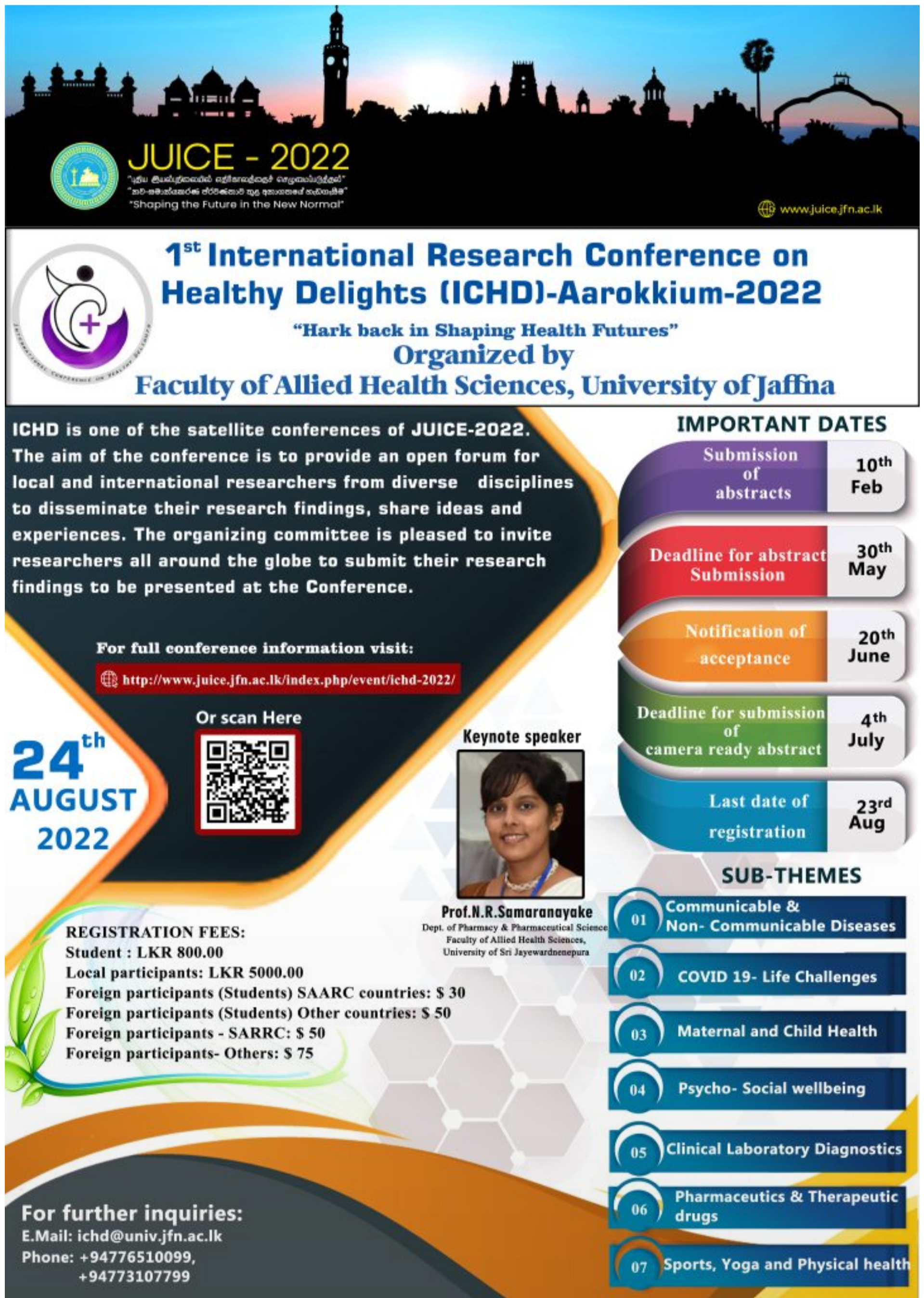
Faculty of Allied Health Sciences, University of Jaffna has organised the 1st International Research Conference on Healthy Delights – ஆரோக்கியம் – 2022 which is one of the satellite conferences of JUICe-2022 under the theme of “Hark Back in shaping Health Futures” as a one-day conference.
This conference provides an opportunity for researchers from diverse health disciplines to explore and disseminate unique, innovative ideas, research findings and promotes healthy interaction between the researchers. This year, twenty-seven abstracts were submitted to the conference in seven different tracts named as Communicable & Noncommunicable Diseases, COVID-19 Life challenges, Maternal and child health, Psychosocial wellbeing, Clinical Laboratory diagnosis, Pharmaceutics and therapeutics and Sports, yoga, and Physical health. Initially, the submitted abstracts were screened to check whether they align with the conference guidelines. Then each of the abstract was sent to two reviewers comprising one internal (University of Jaffna) and one external reviewer in the relevant field in-line with a double-blind review process. Following the blind peer review process 22 abstracts have been accepted for the publication. This unbiased review process has ensured high quality and standard in the publication of the proceedings.
I take this opportunity to thank all the authors for submitting their research findings in our forum and the reviewers for their valuable contribution in the peer review process. I am pleased to acknowledge Dr. S. Saba Ananth, Associate Editor, ICHD 2022, for his valuable input in the preparation of the conference proceedings. I am greatly indebted to thank everyone who pointed out errors and made suggestions for the improvement of the conference proceedings.
 Dr. (Mrs) Srikokulan Sivasinthujah
Chief Editor, ICHD-2022,
Faculty of Allied Health Sciences,
University of Jaffna.
Tackling challenges in transition of care: Is Human factor a redundant solution?
Sri Lanka is made of a diverse community with various health and cultural beliefs. They are open to a wide choice of treatment options including Allopathic, Ayurveda, Siddha, and Unani. Although Primary, Secondary and Tertiary level healthcare services are established by the State, a formal referral system does not exist. Therefore, a Sri Lankan patient can choose to select any one or more of the treatment options available at any desired level of care. It is common to find patients using allopathic and complimentary/traditional/herbal medicines concomitantly.
An average Sri Lankan, during their lifetime, would, receive medicines at a hospital clinic, get admitted to hospital, get transferred to different units within a hospital or between hospitals, be discharged from hospital to home, receive medicines at the community pharmacy, receive complimentary medicines at a care point, and receive medicines from friends or family. Such ‘movements of patients between home, hospital, residential care settings and consultations with different health care providers’ is termed as ‘transition of care’. Transition of care is complex.
Especially in a country like Sri Lanka, healthcare professionals at different points of care standalone and lack collaboration. Poor communication at transition of care, among healthcare providers, and with patient, result in potentially harmful medication discrepancies. Lack of medication reconciliation and review, lack of access to health records, and lack of patient engagement and education are also known to result in medication related harm at transition of care. As it appears, a lapse in the human factor is a major contributor towards the challenges in transition of care. Perhaps strengthening the human factor, itself is the prudent solution at hand to tackle this problem.
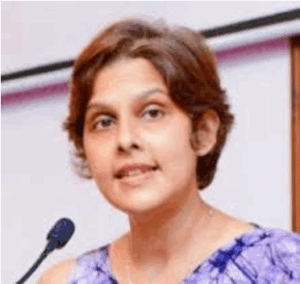 Samaranayake N.
Professor,
Department of Pharmacy and Pharmaceutical Sciences,
Faculty of Allied Health Sciences,
University of Sri Jayewardenepura.